
blog
Are Fall Markdowns Costing Garden Centers More Than Margin?
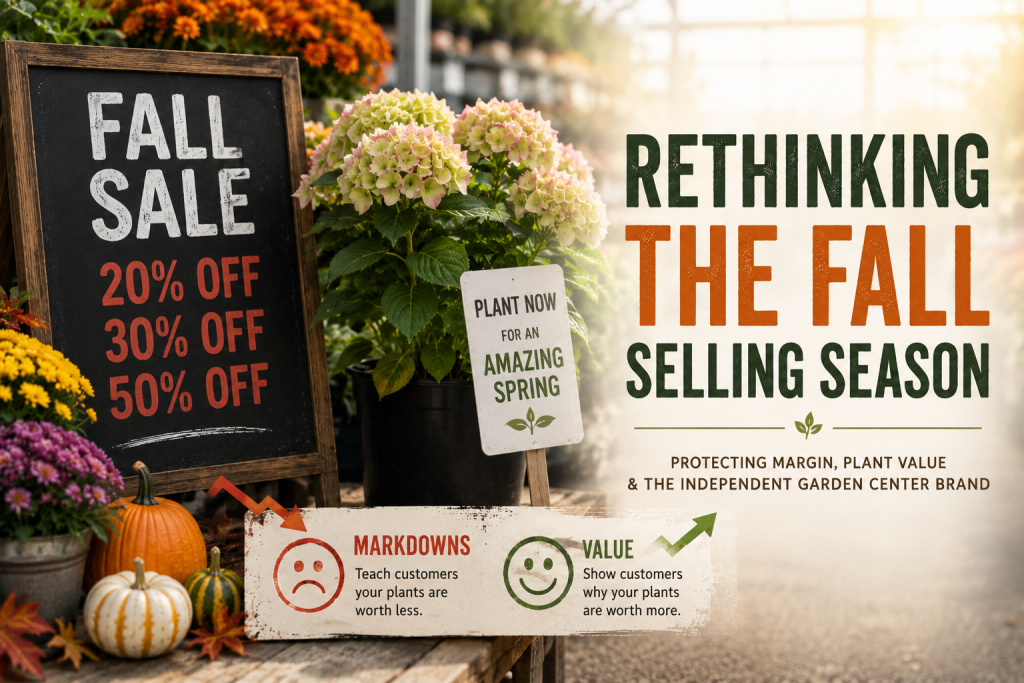
Every fall, a familiar pattern appears at independent garden centers.
Summer winds down. Plant traffic slows. Inventory remains on the benches. And out come the signs:
20% OFF. 30% OFF. 50% OFF.
The objective makes sense. Plants are living inventory, winter is coming, and nobody wants to carry excess merchandise.
But there may be a bigger cost to fall markdowns than the margin we surrender at the register.
What are those sale signs teaching our customers about the plants we’re selling?
The Fall Quality Paradox
Consider a healthy hydrangea priced at $39.99 in August.
If that same healthy hydrangea is marked down 25% in September, what changed?
The genetics didn’t change. The plant didn’t suddenly become less capable of thriving in someone’s landscape.
The calendar changed.
Yet the message we’re sending the customer may be:
This plant isn’t worth as much anymore.
Research into retail discounting suggests consumers use price as information. Deep discounts can negatively affect perceptions of quality, while repeated promotions can establish a lower reference price for what customers believe an item “should” cost.
That’s particularly concerning for independent garden centers.
Our competitive advantage has never been being the cheapest place in town. It’s quality, selection, knowledge and service.
So why spend spring convincing customers our plants are worth more — and fall convincing them they’re worth less?
That’s the Fall Quality Paradox.
The Math Gets Ugly Quickly
Suppose a plant costs the retailer $20 and sells for $40. At full retail, it generates $20 in gross-margin dollars.
Mark it down 20%, and the selling price becomes $32.
The retailer didn’t lose 20% of its gross-margin dollars.
It lost 40%.
At 30% off, gross-margin dollars fall from $20 to just $8 — a 60% reduction.
Moving inventory and making money are not necessarily the same thing.
Are We Training Customers to Wait?
Repeated fall discounting can teach another lesson: patience pays.
Once customers learn that September’s $39.99 perennial reliably becomes October’s $29.99 perennial, waiting becomes rational.
And our most loyal, frequent customers may be the ones who learn the pattern fastest.
What If Fall Isn’t a Clearance Season?
Consumer research suggests meaningful plant purchasing continues into fall.
Proven Winners found that 34% of consumers shop for plants during fall, while another 39% shop throughout the year. Its perennial research found that nearly half of respondents purchased perennials during September or October, with quality — not price — the most important factor for 43%.
Perhaps consumers aren’t telling us they’re finished gardening.
Perhaps we’re telling them the season is finished.
Instead of PERENNIALS — 30% OFF, what about Plant Now for an Amazing Spring?
Instead of discounting individual mums, create a Fall Front Porch Collection combining mums, grasses, pumpkins and seasonal décor.
Instead of discounting trees and shrubs, offer a Fall Planting Bonus — spend $100 today and receive a $15 reward toward a return visit next spring.
The plant retains its value. The customer receives an incentive. And the garden center creates another visit.
Grade the Plants Before You Mark Them Down
None of this means markdowns should disappear. Living inventory is perishable inventory.
But instead of putting a sale sign in front of an entire department, walk the benches and grade the inventory.
A — Premium
Excellent condition and seasonally relevant. Keep it at full price.
B — Sellable
Healthy but moving beyond peak presentation. Bundle it, reposition it or add value.
C — Exit
Quality declining or seasonal relevance disappearing. Use a targeted markdown.
D — Unsellable
No longer represents your garden center’s quality standards. Remove it.
It’s a simple distinction, but an important one.
Mark down the plant that needs to be marked down — not the entire season.
A healthy perennial shouldn’t inherit a 30% discount simply because it’s sitting next to one that’s past its prime.
And putting a big sale sign in front of unattractive plants may be the worst message of all. At that point, we’re not advertising value.
We’re advertising poor quality.
Maybe We’re Asking the Wrong Question
For years, the fall question has often been:
“How much do we have to mark this down to get rid of it?”
Perhaps the better question is:
“How can we make this worth full price?”
We’ve prepared a comprehensive research report examining fall consumer behavior, markdown economics, consumer perceptions and strategies garden centers can use to protect both margin and their reputation for quality.
Read the Comprehensive Report
Rethinking the Fall Selling Season: Protecting Margin, Plant Value and the Independent Garden Center Brand
Fall doesn’t have to be the season when garden centers surrender margin.
It may be one of the industry’s biggest opportunities to create it.
