
blog
ANSWER: Be There When Your Customer Has a Question
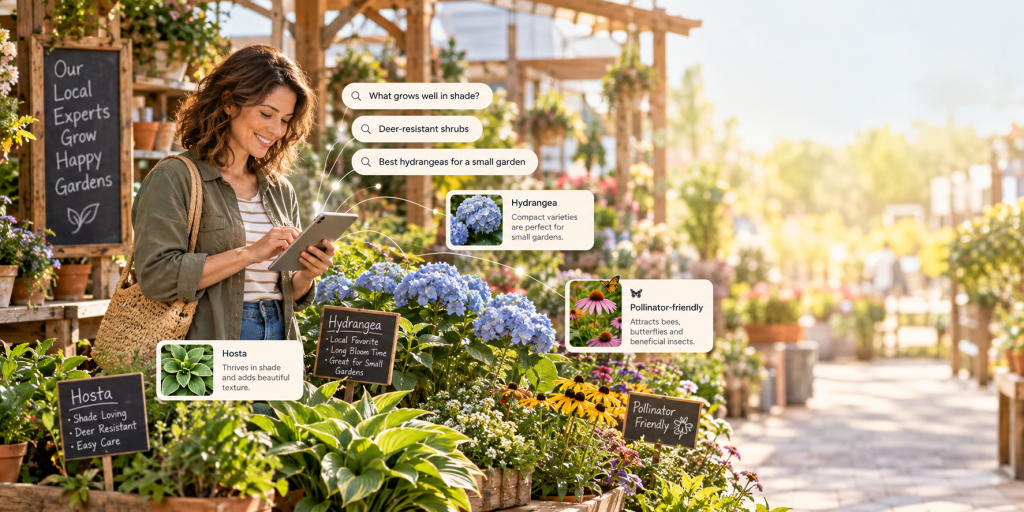
Last week, we introduced three ideas that we believe will increasingly shape the digital relationship between independent garden centers and their customers:
Answer. Guide. Connect.
Over the next few weeks, we’re going to take a closer look at each one, beginning with ANSWER.
Independent garden centers have always had something their larger competitors struggle to replicate: knowledge.
You know which hydrangeas perform best in your area. You know what to plant in a difficult shady corner. You know which perennials the deer are likely to leave alone, when it’s time to fertilize, and what will provide color well into fall.
The challenge isn’t having the answers.
It’s making those answers available when and where your customers are looking for them.
The Question May Come at 8:30 Tonight
Today’s customer doesn’t always wait until Saturday morning to walk into the garden center and ask someone a question.
They may be standing in their backyard wondering what to plant along a fence. They may be searching Google for a deer-resistant shrub. Increasingly, they may simply ask an AI assistant.
That changes the role of your website.
For years, garden center websites primarily told people who you are, where you’re located, when you’re open and generally what you sell.
Today, your website has the opportunity to become a digital extension of the knowledge that already exists inside your garden center.
Build the Knowledge Before You Build the Technology
Every useful piece of information you add makes that resource stronger.
Gardening articles. FAQs. Plant information. Seasonal advice. Product descriptions. Videos.
Together, they create a growing digital knowledge base about your business and your expertise.
That’s one reason Sunrise places so much emphasis on ongoing content for our website clients.
We add fresh gardening content and FAQs every month, update plant information throughout the season, and continually add useful material that reflects what customers are looking for at that time of year.
Over time, that adds up.
In some cases, when we’ve trained an AI assistant on a client’s website and related resources, the knowledge base has included more than 1,000 pages of content.
That matters because better information leads to better answers.
Your Products Are Part of the Answer
Consider the difference between a website that says:
“We carry a great selection of shrubs, perennials and annuals.”
…and one containing hundreds or thousands of individual plants and products with names, photographs, descriptions, characteristics and uses.
The second website doesn’t simply have more products on it.
It knows more.
And not every product needs to be available for online purchase for that information to have value.
A deeper online catalog can help customers discover a particular hydrangea, find plants for shade, explore pollinator-friendly choices or better understand what your garden center offers.
When products are available for online ordering, local pickup or direct shipping, another layer of useful information and convenience is added.
Every plant description, product page, FAQ and gardening article makes your website a little smarter.
Collectively, they begin transforming a traditional garden center website from an online brochure into a searchable gardening resource.
They also give search engines and emerging AI-driven discovery tools more information with which to understand your business, what you know and what you offer.
AI Changes How We Access It
Until recently, customers still had to find all of that information themselves.
They clicked through menus, searched the website and read through pages.
Conversational AI changes that experience.
Instead of searching through a website, a customer can simply ask:
“I have a sunny area along my driveway. What could I plant there that deer won’t eat?”
Or:
“What hydrangeas stay under four feet tall?”
The technology isn’t replacing the garden center’s expertise.
It’s creating a new way to access it.
You Don’t Have to Create Everything Yourself
Building a useful digital knowledge base doesn’t mean someone at the garden center has to write information about thousands of plants.
Much of that knowledge already exists.
Supplier information, horticultural databases, plant descriptions and other trusted resources can provide tremendous depth. Your own website adds the information that is uniquely yours—your services, policies, events, local experience and product selection.
Combine those resources thoughtfully and the knowledge that was once available primarily when an experienced employee was standing nearby can increasingly become available anywhere and anytime.
Start With the Answer
Independent garden centers don’t have an information problem.
They have an access opportunity.
You already possess an enormous amount of knowledge. Your suppliers and industry partners possess even more. And your website can increasingly become the place where all of that information comes together.
When your customer has a question, make it easier for your garden center to be there with the answer.
And once we’ve answered the question, there’s another opportunity:
Help them figure out what to do next.
That’s where GUIDE comes in.
We’ll explore that next week.
